About the Journal
Online https://e-journals2.unmul.ac.id/index.php/mes
E-ISSN: 2987-6753
Publisher: Department of Aquatic Resources Management, Faculty of Fisheries and Marine Science, Mulawarman University
First Publication: 2022
Period of issuance: Tropical Aquatic Science issued Bimonthly, April and October
Aims and Scope: Tropical Aquatic Science aims to provide a reliable platform for researchers, academics, and practitioners to publish original research and review articles in the field of fisheries and marine sciences. Consistent with its name, the journal places a special emphasis on studies conducted in or highly relevant to tropical environments.
The scope of the journal encompasses, but is not limited to:
-
Aquatic Ecology and Biology
-
Hydrology and Water Quality
-
Riverine and Marine Pollution
-
Oceanography and Coastal Management
Article types
Jurnal Tropical Aquatic Sciences seeks and publishes original full-length research papers and review articles. The word limit varies based on the type of manuscript submitted:
-
Original Research Papers: Must be written in no more than 6,000 words (including tables, figures, and references).
-
Review Articles: Must be written in no more than 8,000 words (including tables, figures, and references).
Please note that this journal does not accept or publish short communications.
Indexing The journal has been indexed/registered in Sinta, Google Scholar, Crossref, etc.
Announcements
Current Issue
Vol. 5 No. 1 (2026): Jurnal Tropical Aquatic Sciences
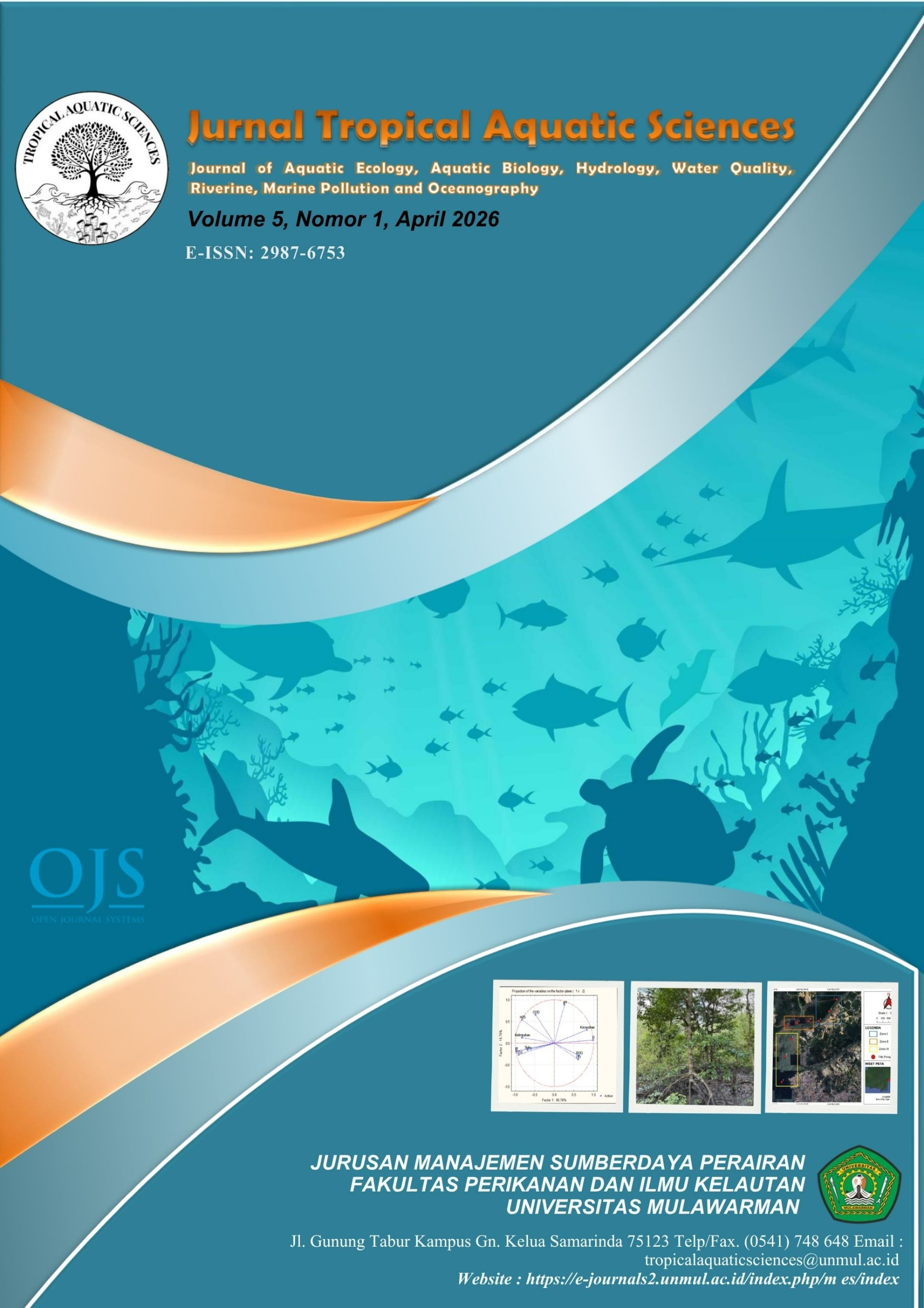
Vol. 5 No. 1 (2026) contains a collection of scientific research conducted by lecturers, researchers, and students within the Faculty of Fisheries and Marine Sciences, Mulawarman University. The research presented covers various aspects of aquatic ecosystems, including the community structure of macrozoobenthos as a bioindicator of pollution in the Karang Mumus River; a study of fish communities in the seagrass beds of Malahing Village, Bontang City; litter production and density in the Graha Indah Mangrove Center, Balikpapan; characteristics of macroplastic debris trapped in the seagrass beds of Badak-Badak Island, Bontang; abundance and distribution patterns of macro bivalves in the seagrass ecosystem of Badak-Badak Island; the relationship between seagrass density and macrozoobenthos abundance in Selangan Waters, Bontang; the diversity characteristics of macro gastropods in the seagrass beds of Badak-Badak Island; mangrove community structure in the Sambera Mangrove Coast, Tanjung Limau Village, Muara Badak; water quality status of the Benanga Reservoir, Samarinda, using the NSF-WQI method; community structure and phytoplankton abundance in the Wain River Estuary, Balikpapan; and estimation of litter production rate and health assessment of the mangrove forest at Pasir Mayang Beach, Paser. The discussions presented are comprehensive and scientific, making them useful for the community and enriching the body of knowledge in fisheries and marine sciences, particularly in East Kalimantan.
Published:
30-04-2026
Full Issue
Articles
|
|
hh |
Jurnal Tropical Aquatic Sciences (TAS) is a means for researchers in the field of Fisheries and Marine Science to publish scientific research results. First published in 2022 with a biannual publication period in April and October. This journal has been accredited SINTA 4, which is valid until Volume 6, Issue 2 (2027). The TAS Editorial Board consists of Fisheries and Marine Science lecturers in various areas of expertise concentration such as aquatic ecology, aquatic biology, hydrology, water quality, riverine marine pollution, and oceanography. For editorial information, information and services, please contact tropicalaquaticsciences@unmul.ac.id. Each published article in this journal has a Digital Object Identifier (DOI) based on the edition and article number. Reviewers will review any submitted paper. The review process employs a double-blind review, which means that both the reviewers and authors' identities are concealed from each other.
|