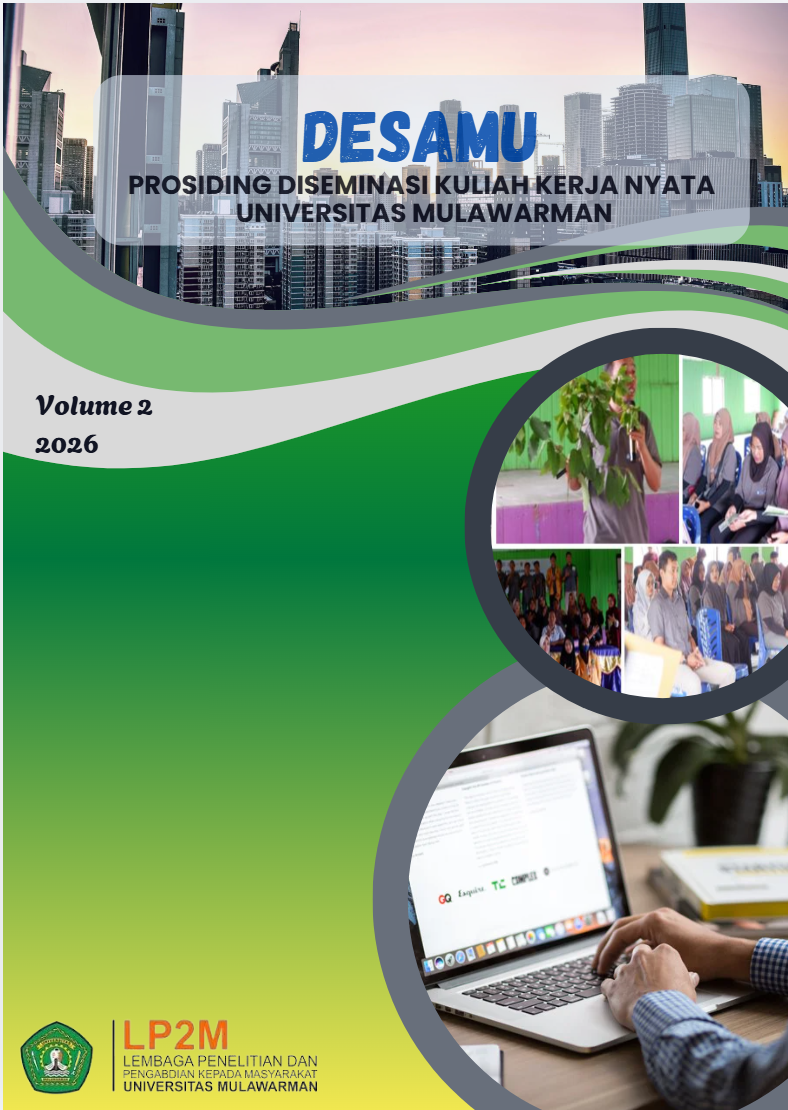
Penguatan Literasi Keuangan Siswa Sekolah Dasar Negeri 014 Muara Badak sebagai Kontribusi Perguruan Tinggi terhadap SDG 4 (Pendidikan Berkualitas)
Strengthening Financial Literacy of Elementary School 014 Muara Badak Students as a Higher Education Contribution to SDG 4 (Quality Education)
DOI:
https://doi.org/10.30872/mq0h7r89Keywords:
Financial Literacy, Elementary School Students, Education, Community Service Program, SDGsAbstract
Financial literacy is an important competency that should be introduced at the elementary school level to foster students understanding and responsible financial management habits. This community engagement program aimed to improve elementary school students financial literacy through a financial education program implemented as part of the Community Service Program (Kuliah Kerja Nyata/KKN). The program involved 27 students from grade 4 to 6 and imployed a participatory learning approach through interactive intruction, discussions, simulations, and educational activities. Program effectiveness was evaluated using a pre-test and post-test design to assess changes in participants understanding before and after intervention. The data were analyzed descriptively by comparing the mean, minimum, and maximum scores obtained from the pre-test and post-test. The results showed the participants mean score increased from 78,70 in the pre-test to 88,89 in the post-test, representing an increase of 10,19 points (12,95 %). This program reflcets the university’s tangible contribution to achieving the Sustainable Development Goals (SDGs), particularly SDG 4 (Quality Education), while indirectly supporting SDG 1(No Poverty) and SDG 8 (Decent Work and Economic Growth) by equipping young learners with essential money management skills from an early age.
Downloads
Published
Issue
Section
License
Copyright (c) 2026 Andi Aqil Ajrun Adhim, Muhammad Fadillah, Najwa Alnov Fitri, Jhon Calvin Sipayung, Gracia Aurellita Telan Bith, Deswita Dwiaurelian Galla, Damas Prasetyo Utomo, Ahmad Rohid Solihin, Devan Dwi Bonanda, Muhammad Akmal, Edith Abram Rochdi, Mayusef Sukmana (Author)

This work is licensed under a Creative Commons Attribution-NonCommercial-ShareAlike 4.0 International License.